The Great Indian Retail Battle
India's grocery retail market — valued at over $600 billion — is witnessing one of the most fascinating competitive dynamics in global retail. On one side are over 12 million kirana stores that have served Indian consumers for generations. On the other are modern supermarket chains, hypermarkets, and increasingly, online grocery platforms. The question that retailers, analysts, and policymakers keep asking is: can kirana stores survive?
The short answer is yes — but not without adapting. The longer answer requires understanding what each format does well, where gaps exist, and how smart kirana owners are evolving to hold their ground. For a comprehensive three-way comparison, see our detailed guide on Kirana vs Supermarket vs Online Grocery.
Understanding the Two Models
The Kirana Store Model
A typical kirana store is a 100–500 square foot neighbourhood shop, usually owner-operated with minimal staff. Its advantages are deeply structural:
- Proximity: There is a kirana store within 500 metres of almost every Indian household. This unmatched last-mile presence is nearly impossible for organised retail to replicate at scale.
- Personal relationships: The kirana owner knows customers by name, understands their preferences, and provides a personalised shopping experience.
- Credit (Udhar): Extending informal credit to trusted customers is a service that no supermarket or online platform can match.
- Low overhead: Minimal rent, no air conditioning costs, family labour, and simple operations keep costs low.
- Flexibility: Kirana stores can adapt their product mix overnight based on customer feedback, stock what their specific neighbourhood demands, and respond to local events and seasons instantly.
The Supermarket Model
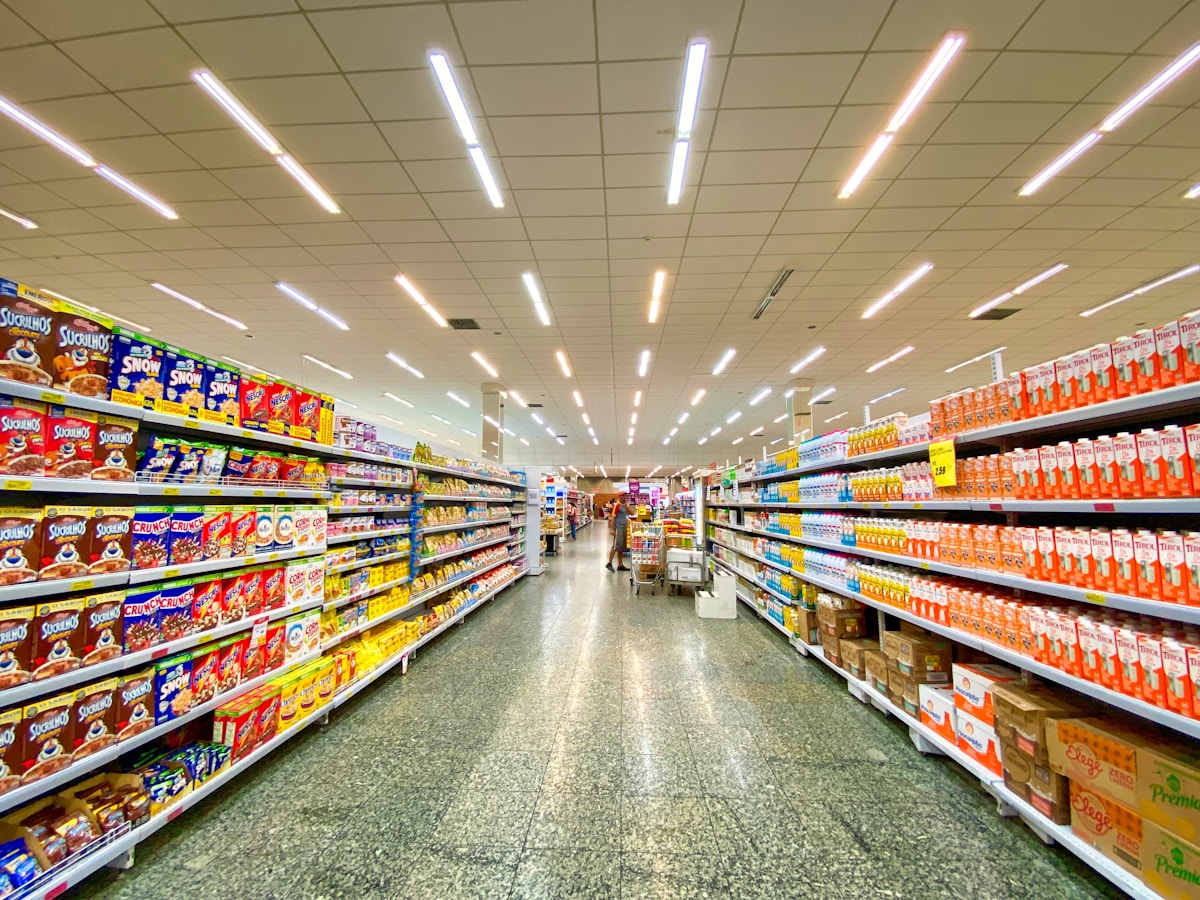
Modern supermarkets like Laxmi Super Mart operate on a fundamentally different model built on scale, standardisation, and efficiency:
- Product range: A typical supermarket stocks 5,000–30,000 SKUs compared to 500–2,000 in a kirana store, offering far greater variety and choice.
- Pricing: Bulk procurement, direct brand relationships, and EDLP (Everyday Low Pricing) strategies can offer consumers better prices, especially on branded products.
- Shopping experience: Air-conditioned spaces, organised aisles, fresh produce sections, and self-service browsing provide a modern shopping experience.
- Quality assurance: Standardised supply chains, cold chain infrastructure, and quality checks ensure consistent product quality.
- One-stop shopping: From groceries and fresh produce to household items and personal care, supermarkets offer everything under one roof.
Where Kiranas Win
Despite the apparent advantages of supermarkets, kirana stores retain several unbeatable strengths:
1. Convenience and Accessibility
A consumer needing a packet of milk, a bar of soap, or a kilo of onions at 9 PM will walk to the neighbourhood kirana, not drive to a supermarket. This convenience factor drives daily footfall that supermarkets cannot capture. In Rajasthan's smaller towns and rural areas, the kirana store is often the only retail option within practical distance.
2. Trust and Social Capital
The kirana owner is a member of the community. This social embedding creates a level of trust that corporate brands spend crores trying to build. Customers forgive a kirana owner for an occasional pricing error but hold supermarkets to higher standards. This asymmetry works powerfully in the kirana's favour.
3. Credit Facility
Informal credit remains one of the kirana store's most potent competitive weapons. An estimated 30–40% of kirana transactions involve some form of credit. For price-sensitive consumers managing tight monthly budgets, the ability to buy on credit and pay at month-end is genuinely valuable.
4. Low Breakeven Point
A kirana store can be profitable with daily sales as low as ₹3,000–5,000. A supermarket needs daily sales in lakhs to cover its fixed costs. This low breakeven makes kirana stores remarkably resilient — they survive economic downturns, pandemics, and competitive pressures that would shutter larger format stores.
Where Supermarkets Win
1. Pricing on Branded Products
Direct procurement from manufacturers, volume discounts, and promotional partnerships allow supermarkets to offer branded FMCG products at prices that individual kirana stores struggle to match. Laxmi Super Mart, for example, leverages its procurement scale to offer competitive pricing across thousands of products.
2. Fresh Produce and Quality
Modern supermarkets invest heavily in cold chain, quality control, and fresh produce sourcing. For consumers who prioritise freshness, variety, and food safety — particularly in fruits, vegetables, dairy, and meats — supermarkets offer a demonstrably superior proposition.
3. Private Labels
Supermarket chains develop private label products at 10–30% lower prices than national brands with competitive quality. This category is virtually unavailable through kirana stores and gives supermarkets a unique price-value proposition.
4. Discovery and Aspirational Products
Supermarkets introduce consumers to new brands, imported products, organic ranges, health foods, and premium categories. A consumer may discover quinoa, olive oil, or Korean ramen at a supermarket — products that most kirana stores do not stock.
How Smart Kirana Stores Are Fighting Back
The most successful kirana owners are not passively waiting for supermarkets to erode their business. They are actively adopting strategies to compete:
1. Technology Adoption
Digital payments (UPI), WhatsApp Business for orders, and B2B sourcing apps like MyKiranaBuddy (on the Google Play Store) are helping kirana stores improve efficiency, reduce costs, and reach customers digitally.
2. Home Delivery
Many kirana stores now offer phone and WhatsApp-based ordering with free home delivery — combining the convenience of online shopping with the trust and credit advantages of the neighbourhood store.
3. Niche Specialisation
Some kirana owners are specialising in specific categories — organic products, regional specialities, premium brands, or health foods — to differentiate from both supermarkets and other kiranas.
4. Better Store Experience
Upgrading shelving, improving lighting, maintaining cleanliness, and adding a small refrigerated section can dramatically improve the in-store experience without massive investment.
5. Smarter Sourcing
Using wholesale platforms to access better pricing and wider product ranges helps kirana stores narrow the price gap with supermarkets.
The Coexistence Thesis
The reality is that India's grocery market is large enough for all formats to thrive. Consumer behaviour is not binary — the same household may buy monthly staples from a supermarket, order occasional speciality items online, and rely on the neighbourhood kirana for daily top-ups and emergency purchases.
At Laxmi Super Mart, we believe in a retail ecosystem where organised and traditional trade complement each other. Supermarkets expand the overall market by introducing new categories and raising consumer expectations, while kirana stores ensure last-mile access and personalised service that no large format can replicate.
The real loser in this competition is not the kirana store or the supermarket — it is the store in either format that fails to understand and serve its customers effectively.
What the Data Tells Us
Despite the growth of organised retail and e-commerce, kirana stores still command approximately 80% of India's grocery market. This share has declined from 90%+ a decade ago, but the decline is gradual, not catastrophic. Moreover, the total market is growing rapidly — so even a declining share can mean growing absolute sales for kiranas.
In Rajasthan specifically, organised retail penetration remains below the national average, meaning kirana stores have even more runway. However, this is changing rapidly as chains expand into tier-2 and tier-3 cities.
The Verdict: Competition Elevates Everyone
Can kirana stores compete with supermarkets? Absolutely — but they must play to their strengths rather than trying to imitate a format they cannot replicate. The kirana store's moat is proximity, trust, credit, and personalised service. By layering modern tools and efficient sourcing on top of these foundations, the neighbourhood kirana can remain not just competitive but indispensable.
For kirana owners ready to modernise their operations, start with our guides on starting a kirana store in Rajasthan and the top FMCG products every kirana must stock. The future belongs to those who evolve — regardless of their store size.
Frequently Asked Questions
What percentage of India's grocery market do kirana stores still control?
Kirana stores still command approximately 80% of India's grocery retail market. While this share has declined from over 90% a decade ago, the total market is growing, so many kirana stores are seeing growth in absolute sales despite the declining market share percentage.
What is the biggest advantage kirana stores have over supermarkets?
Proximity and convenience are the kirana store's strongest advantages. With a store within 500 metres of most Indian households, kiranas capture daily top-up purchases and emergency shopping occasions that supermarkets cannot serve efficiently. Credit facility and personal trust are also major differentiators.
Can a kirana store offer prices as low as supermarkets?
On branded products, kiranas typically cannot match supermarket prices due to differences in procurement scale. However, by using B2B sourcing platforms like MyKiranaBuddy, kirana stores can narrow this gap significantly. On loose staples and local products, kiranas can often match or beat supermarket pricing.
How are kirana stores adapting to compete with modern retail?
Smart kirana owners are adopting digital payments, using WhatsApp for orders, offering home delivery, improving store layouts, and using B2B wholesale apps for better sourcing. Some are specialising in niche categories to differentiate from both supermarkets and online platforms.
Will supermarkets eventually replace kirana stores in India?
No. India's geography, demographics, and consumer habits make it virtually impossible for any single format to dominate. The most likely outcome is coexistence, where supermarkets serve planned shopping occasions while kirana stores handle daily convenience purchases. Both formats will evolve and find their niches.
Find Your Nearest Laxmi Super Mart
85+ stores across Rajasthan and India with everyday low prices on 10,000+ products.
Find a Store

Laxmi Mart Editorial
The Laxmi Mart Editorial team brings you the latest insights on grocery shopping, product guides, and smart living tips from India's trusted supermarket chain with 85+ stores across Rajasthan.
 B2B & Wholesale